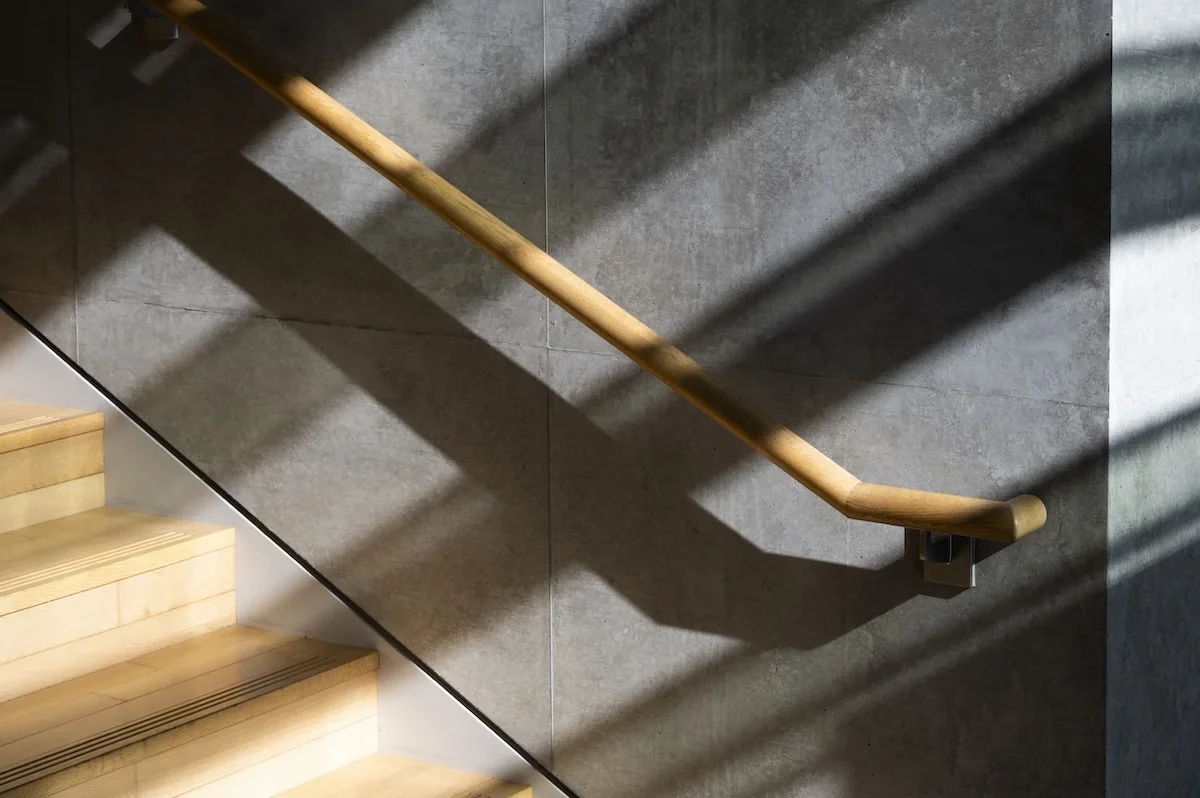
A wooden handrail is one of those details you notice every time you use a staircase – even if you do not consciously think about it.
It should feel comfortable and reassuring in the hand. It should follow the staircase naturally. And because a handrail creates a strong visual line through a hallway, landing or entrance space, its timber, profile and finish can have a surprisingly large effect on the character of the interior.
For some homes, a simple oak handrail is exactly right. For others, the staircase calls for a more distinctive hardwood, a traditional moulded profile, a sweeping curve or a hand-carved terminal that feels as though it has always belonged there.
At RR Interior, we create bespoke wooden handrails and staircases for modern, traditional and historic properties. In this guide, we explain what to consider when choosing a wooden handrail for stairs, from timber species and profiles to finishes, regulations and the difference between bespoke joinery and an off-the-shelf handrail kit.
Why Choose a Wooden Handrail for Your Stairs?
Wood has a quality that is difficult to reproduce in other materials. It is warm to the touch, naturally varied and capable of feeling either understated or highly decorative depending on how it is shaped and finished.
A well-designed wooden stair handrail can work in almost any style of interior. Clean oak and restrained profiles can suit contemporary spaces, while richer hardwoods, mouldings, scrolls and carved details can sit beautifully within period homes.
There are practical advantages too. Quality timber is durable, can be refinished as it ages and can often be repaired or restored rather than discarded. This is particularly valuable in older properties, where maintaining the character of existing joinery may be just as important as introducing something new.
The versatility of timber also means a wood handrail for stairs can be designed to relate to other elements in the home. It might echo an oak floor, pick up the tone of existing doors, complement the staircase itself or provide a deliberate contrast.
The most successful result is rarely about choosing wood in isolation. Timber, profile, proportion and finish need to work together.
What Is the Best Wood for a Stair Handrail?
There is no single timber that is right for every staircase. The best wood for a handrail depends on the appearance you want, how the staircase is used, the surrounding joinery and whether the timber will be left visible, stained, oiled, lacquered or painted.
For bespoke work, we prefer to look at the whole interior before recommending a species. The grain that looks beautiful on a sample can feel very different once it becomes a long, continuous handrail running through a hallway.
Oak Handrails
Oak is one of the most popular choices for a wooden handrail for stairs, and for good reason.
It is a durable hardwood with a distinctive grain and a naturally substantial feel. Depending on the profile and finish, an oak handrail can look traditional, rustic, refined or distinctly contemporary.
Oak works particularly well where the handrail will remain visibly timber rather than being painted. Clear oils and other natural-looking finishes can bring out the grain and warmth of the wood, while stains can deepen or alter its tone to sit more comfortably alongside existing joinery.
An oak handrail can be a natural choice for an oak staircase, but everything does not have to match exactly. In some interiors, subtle differences between the staircase, flooring and handrail create a more layered and considered result.
Oak is especially worth considering if you want:
- a strong, durable hardwood;
- visible natural grain;
- a timber that works in both period and contemporary interiors;
- plenty of flexibility in profile and finish; or
- a handrail designed to become a lasting architectural feature rather than simply a functional addition.
Other Hardwood Stair Handrails
Oak may be familiar, but it is far from the only option.
Other hardwoods can offer very different colours, grain patterns and levels of visual richness. Depending on the project, species such as walnut, ash, beech, maple and other suitable hardwoods may be considered.
Walnut, for example, can introduce a deeper, more luxurious tone. Ash tends to feel lighter and can display a lively grain. Beech can provide a more uniform appearance. The right choice depends less on which wood is considered the most prestigious and more on what will work with the architecture and interior around it.
A hardwood stair handrail is particularly effective when the wood itself is intended to be seen and appreciated. The grain can become part of the design, especially on long rails, curved sections and larger profiles where the timber has room to express its character.
During consultation, we can look at the staircase and surrounding space with you and help decide which hardwood will achieve the right balance of colour, grain, durability and style.
Pine and Other Softwoods
Pine can be a practical choice for some stair handrails, particularly where cost is an important consideration or the finished handrail will be painted.
As a softwood, pine is generally more susceptible to dents and wear than denser hardwoods. It also has a different visual character, so it may not provide the same sense of depth or refinement when left as exposed timber.
That does not make it unsuitable. In the right project, especially where a painted handrail is intended to blend with existing staircase joinery, pine can be entirely appropriate.
The important question is not simply, “Is hardwood better than pine?” It is, “Which timber best suits this staircase, this finish and this home?”
Which Timber Should You Choose?
As a simple starting point:
Choose oak if you want a durable, characterful and versatile natural timber that can move comfortably between traditional and contemporary interiors.
Consider another hardwood if you want a particular colour, grain pattern or visual character that oak does not provide.
Consider pine or another appropriate softwood where the handrail will be painted, the design is relatively simple or budget is a key priority.
For a bespoke handrail, you do not need to make that decision alone. Wood and finish are two of the details we help you determine during consultation.
What Is the Difference Between a Handrail and a Banister?
The terms are often used interchangeably, but technically they are not quite the same thing.
A handrail is the rail you hold as you walk up or down the stairs. A banister is a more informal term commonly used for the wider balustrade or guarding assembly around a staircase, which may include the handrail, spindles or balusters, newel posts and associated components.
So when someone searches for a wooden banister handrail, they will often be referring specifically to the timber rail that sits at the top of the staircase balustrade.
The distinction becomes useful when planning work. You may want to replace only the handrail while keeping the existing newel posts and balusters, or you may be considering a complete redesign of the whole balustrade.
Choosing the Right Wooden Handrail Profile
The profile is the cross-sectional shape of the handrail. It affects both appearance and grip, making it one of the most important design decisions after the timber itself.
A small change in profile can completely alter how a staircase feels. A rounded handrail can appear soft and familiar. A square or chamfered profile can feel architectural and contemporary. A traditional moulding can give a period staircase the depth and detail it needs.
For bespoke work, we can also create profiles around the staircase rather than being limited to a small catalogue of standard shapes.
Mopstick Handrail
A mopstick handrail has a simple, rounded form. It is one of the most recognisable handrail profiles and is commonly used for wall-mounted stair rails.
Its uncomplicated shape makes it versatile. In oak or another natural hardwood, it can feel warm and understated. Painted, it can sit quietly within more traditional staircase joinery.
A mopstick profile can be a good choice where you want the handrail to be comfortable and visually simple rather than highly decorative.
Pig’s Ear Handrail
A pig’s ear handrail is designed to sit directly against the wall rather than being held away from it by conventional handrail brackets.
Its compact form can make it useful where you want to minimise projection into the staircase or create a neat, visually contained wall-mounted rail.
It tends to have a more traditional character than a simple round rail, although the timber and finish can significantly change how it appears in the room.
D-Shaped Handrail
A D-shaped handrail typically combines a flatter underside with a rounded gripping surface.
It provides the comfort of a softened profile while retaining a slightly cleaner, more structured appearance. This can work particularly well in interiors where the staircase needs to feel refined and contemporary without becoming stark.
Chamfered, Moulded and Bespoke Profiles
Standard profiles are useful starting points, but they are not the limit of what a wooden staircase handrail can be.
A bespoke profile can be designed to suit the proportions of the staircase, echo existing architectural details or reproduce original joinery in a historic property. Square-edged profiles can be softened with chamfers. Traditional mouldings can be recreated. Curves can flow into scrolls, ramps, wreaths or other transitions rather than ending abruptly.
This is where hand craftsmanship becomes particularly important.
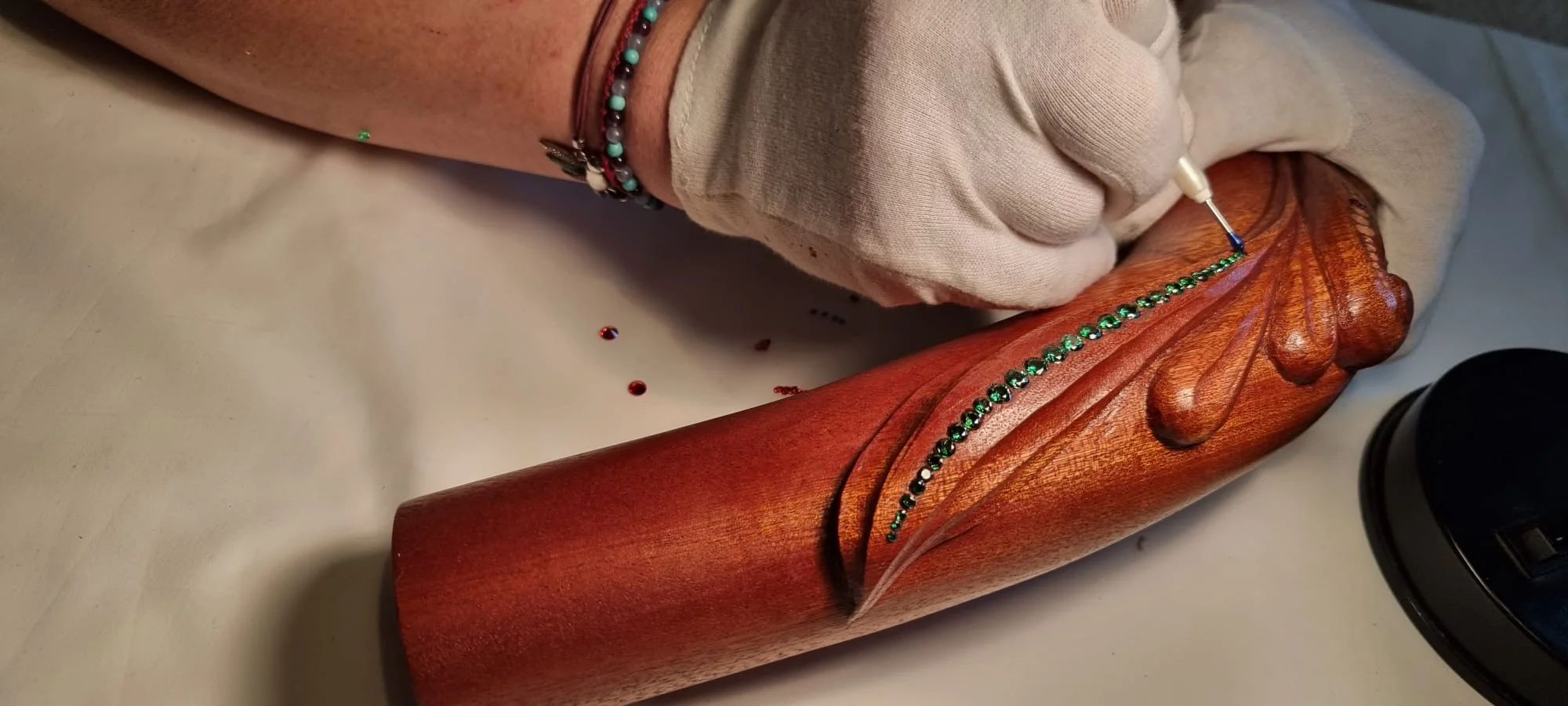
A carved scroll terminal, for example, is not simply decoration attached to the end of a rail. Done well, its lines grow naturally from the profile of the handrail. The same is true of curved and continuous handrails: the transitions need to feel fluid in both the eye and the hand.
At RR Interior, bespoke profiles, hand-carved details, complex curves and traditional forms allow us to respond to the staircase itself rather than asking the staircase to fit a standard component.
Wall-Mounted Handrail or Full Staircase Balustrade?
A wooden handrail can be installed in different ways depending on the staircase.
A wall-mounted handrail runs along the wall beside the steps and is normally supported by brackets or, in the case of profiles such as a pig’s ear, fixed more directly to the wall.
A balustrade handrail forms the upper rail of the guarding at the open side of a staircase. It may connect with newel posts, balusters, panels, glass or other components.
Some staircases use both. For example, an open-sided staircase may have a wooden handrail over the balustrade and a second handrail along the wall opposite.
It is also possible in many cases to introduce a new handrail without replacing the entire staircase. Whether this is straightforward depends on the existing construction, fixing points, geometry and condition of the surrounding joinery.
For period or highly detailed staircases, replacing one element in isolation requires particular care. The new work should relate naturally to the dimensions, mouldings and timber already present.
Bespoke Wooden Handrail vs Off-the-Shelf Handrail Kits
Not every staircase needs a completely bespoke handrail.
For a straightforward flight with standard geometry, an off-the-shelf handrail can be a practical and economical solution. Standard lengths and commonly available profiles are often sufficient when there are no complex changes of direction, unusual proportions or existing details to match.
The distinction becomes more important when the staircase itself is part of the design of the room.
When an Off-the-Shelf Handrail Makes Sense
A standard handrail may suit your project if:
- the staircase is straight and relatively simple;
- standard lengths and profiles fit comfortably;
- you do not need to match existing bespoke joinery;
- the handrail is primarily functional rather than a focal feature; and
- budget is the main consideration.
For the right staircase, there is nothing wrong with keeping things simple.
When a Bespoke Handrail Is Worth Considering
Bespoke joinery becomes particularly valuable when the staircase has to respond to something specific in the home.
That might include:
- a curved or sweeping staircase;
- unusual changes in direction or level;
- a period or listed property;
- an existing moulding that needs to be matched;
- a non-standard handrail profile;
- bespoke scrolls, terminals or carved details;
- continuous handrails with complex transitions;
- a particular timber or finish;
- existing newel posts or staircase components that are being retained; or
- a design in which the handrail is intended to be an important architectural feature.
Bespoke does not simply mean cutting a standard rail to a different length. It means considering the timber, profile, proportions, transitions and finish as part of one design.
That difference can be especially noticeable on a staircase because a handrail is experienced continuously. Your eye follows it through the room and your hand follows it as you move between floors. Awkward joints, mismatched profiles and abrupt transitions become difficult to ignore.
A well-resolved bespoke handrail should feel natural enough that those decisions almost disappear.
Choosing a Finish for a Wooden Stair Handrail
The finish affects far more than colour. It can change the way the grain reads, the sheen of the surface and the tactile quality of the rail in your hand.
The best finish therefore depends on the timber and the desired character of the interior.
Oiled Handrails
Oil is often chosen when the aim is to retain a natural timber appearance and bring out the grain.
An oiled oak handrail, for example, can have a warm, tactile quality that feels particularly appropriate when the beauty of the timber is intended to remain visible.
Different oils can affect the final tone, so samples are useful when the handrail needs to work alongside flooring, doors or other timber elements.
Oiled surfaces may require periodic maintenance depending on use and the finishing system selected.
Lacquered Handrails
Lacquer creates a more sealed surface and can provide a smooth, consistent finish.
Depending on the product and sheen level, it can look subtle and natural or more polished. It is worth thinking about both appearance and touch: a handrail is one of the few pieces of architectural joinery that you physically handle every day.
Waxed Handrails
Wax can produce a soft lustre and traditional feel that suits certain period interiors and restoration projects.
As with oil, the finish becomes part of the character of the timber rather than simply sitting on top of it visually. Maintenance requirements should be considered at the specification stage.
Painted Handrails
Not every wooden handrail needs to display its grain.
Paint can be the right choice where the handrail should blend with painted spindles, skirting, wall panelling or other staircase joinery. It can also allow the shape and profile to become the focus rather than the species of timber underneath.
A painted handrail may suit both traditional and contemporary schemes depending on colour and detailing.
Stained and Custom Finishes
Staining can alter the tone of visible timber while retaining the grain, which can be useful when trying to relate new work to existing flooring or joinery.
The key is not to select a finish from a photograph alone. Timber species, natural variation, preparation and lighting all affect the final appearance.
For that reason, wood and finish are discussed together during our consultation process. We can help determine whether the handrail should match an existing element closely, sit alongside it sympathetically or provide a deliberate contrast.
Matching a Wooden Handrail to Your Interior
A staircase does not exist in isolation. It may be visible from the entrance hall, living space or landing, so the handrail needs to make sense within the wider interior.
Traditional and Period Homes
In a period property, the most successful handrail is often one that feels appropriate to the building rather than conspicuously new.
That may involve selecting a timber with the right depth and character, recreating a moulded profile, matching existing newel posts or incorporating details that reflect original craftsmanship.
For restoration work, restraint can be just as important as ornament. The aim is not to make every element elaborate; it is to understand what belongs in the space.
Where original joinery survives, a new staircase handrail can sometimes be designed around it rather than stripping everything out and beginning again. This is particularly important in historic interiors, where preserving the character of the building can be central to the project.
Contemporary Interiors
In a modern home, wooden handrails can introduce warmth without adding visual clutter.
Lighter oak, simple D-shaped or softened square profiles, clean transitions and restrained finishes can all work well. Timber may also be paired with glass, metal balusters or minimalist staircase structures to create contrast between natural material and sharper architectural elements.
Contemporary does not necessarily mean completely plain. A beautifully proportioned curve or carefully chamfered edge can provide detail without feeling decorative.
Statement Staircases
On a feature staircase, the handrail can become sculptural.
Sweeping curves, continuous rails, carved terminals and carefully considered changes in direction can lead the eye through the space. Here, the relationship between craftsmanship and geometry becomes especially important: the handrail has to look fluid while remaining comfortable to use.
The best statement pieces are not decorative for decoration’s sake. Their form grows from the staircase and the room around it.
What Should You Measure Before Ordering a Stair Handrail?
For a simple wall-mounted handrail, initial measurements can help establish the scope of the project. For a complex bespoke handrail, however, dimensions are only part of the picture.
Useful information can include:
- the approximate length of the staircase or handrail run;
- photographs showing the full staircase;
- landing sections and changes of direction;
- whether the rail will be wall-mounted or part of a balustrade;
- the location and dimensions of existing newel posts;
- curved, winding or unusually shaped sections;
- existing handrail profiles that may need to be matched; and
- architectural drawings or plans, where available.
You do not need to arrive at the first conversation with a perfect technical survey.
Photographs and approximate measurements are often enough to begin discussing the project. Where the geometry is complex, accurate surveying can form part of the bespoke process before manufacture begins.
This is especially important with curved staircases, continuous rails and period joinery. Small dimensional differences can have a large effect once separate components have to meet cleanly and follow the staircase without awkward interruptions.
Stair Handrail Height and UK Building Regulations
A handrail is an architectural feature, but it is first and foremost a safety element. Its height, position, continuity and relationship with the staircase therefore need to be considered alongside its appearance.
For projects in England, Approved Document K gives guidance on protection from falling, collision and impact. For stairs, it states that the top of the handrail should generally be positioned 900mm to 1000mm above the pitch line or floor. It also gives guidance on when handrails are required on one or both sides of a staircase and on other aspects of guarding and stair design.
The correct requirements depend on the building, staircase and nature of the work. Different guidance can also apply outside England, and historic or listed properties may introduce further project-specific considerations.
For that reason, dimensions should not be chosen purely for visual effect or copied from another staircase. Building regulations and any relevant project requirements should be checked as part of the design process.
If you are planning a new staircase or significant alteration, professional advice should be sought for the specific property rather than relying on a general online guide alone.
How Much Does a Wooden Handrail for Stairs Cost?
There is no meaningful single price for a bespoke wooden handrail because the amount of work can vary enormously from one staircase to another.
The main factors include:
- timber species;
- overall length;
- handrail profile;
- straight or curved construction;
- the number and complexity of transitions;
- carved details or bespoke terminals;
- finishing requirements;
- existing staircase components that need to be matched or retained;
- installation requirements; and
- the additional care involved in heritage or restoration work.
A straight oak handrail in a relatively simple profile is fundamentally different work from a continuous hand-carved handrail following the geometry of a sweeping staircase.
For that reason, we prefer to understand the staircase and desired result before discussing the cost of bespoke work. Photographs, plans and an initial conversation can help establish what is involved, after which the specification can be developed more accurately.
Price matters, but it should be considered alongside lifespan, craftsmanship and how well the finished handrail integrates with the home. A staircase is used for years – often generations – so details that initially seem small can become very visible over time.
What Is the Process for Ordering a Bespoke Wooden Handrail?
Clients do not need to know exactly which timber, profile or finish they want before speaking to us.
Every RR Interior bespoke handrail project begins with consultation. It is our job to help turn an idea, an existing staircase or a practical requirement into a considered specification.
1. Consultation
We begin by discussing the staircase, the property and what you want the finished handrail to achieve.
You may already have a clear visual direction, or you may simply know that the current handrail feels wrong for the space. Both are perfectly good starting points.
During the consultation, we can help you decide on the most suitable wood species, handrail profile and finish, taking into account the style of the interior, existing joinery, practical requirements and the character you want to create.
It is helpful to share any information you have, such as:
- photographs of the staircase and surrounding room;
- architectural drawings or plans;
- approximate dimensions;
- images of handrail styles you like; and
- details of floors, doors, furniture or existing timber that you want the new work to complement.
The consultation is there to guide the decisions, not simply record choices you have already made.
2. Design and Specification
Once the overall direction is clear, the handrail can be developed in more detail.
This may include refining the profile, proportions, transitions, terminal details and how the handrail relates to newel posts, balusters, walls or existing parts of the staircase.
For restoration work, this stage can also involve studying original mouldings and details so that new joinery sits comfortably beside what is being retained.
3. Survey Where Required
Straightforward projects may need relatively simple measurements. More complex staircases often benefit from a detailed survey before manufacture.
Curves, winders, changes in level and continuous handrails require particular accuracy. A survey allows the geometry of the staircase to inform the workshop work rather than relying on assumptions.
4. Workshop Craftsmanship
Once the design is agreed, the handrail is made to the specification.
This is where timber selection and craftsmanship come together. The wood is shaped into the required profile, transitions are resolved and any bespoke carving or decorative details are created by hand where the design calls for them.
On more intricate pieces, the process may involve sweeping curves, scroll terminals, swan-neck forms or profiles that need to flow through changes in direction without losing their visual rhythm.
The finish is then applied to achieve the agreed tone, texture and level of sheen.
5. Delivery and Installation
The completed handrail is delivered and installed as required for the project.
Lead times vary depending on the timber, design complexity and scope of work. Once the design is agreed, we provide clear expectations around the project timeline so you understand the process from manufacture through to installation.
Caring for a Wooden Handrail
A quality wooden handrail does not require complicated day-to-day care, but the correct approach depends on the finish.
For routine cleaning, avoid harsh abrasives and aggressive chemicals that may damage the coating or alter the surface. Dust and light marks can usually be handled with gentle cleaning appropriate to the finish used.
Oiled and waxed handrails may occasionally require maintenance or reapplication. Lacquered and painted surfaces have different care requirements, so it is always worth knowing which finish has been applied before using a cleaning product.
One of the advantages of good timber joinery is that age does not automatically mean replacement. Depending on its condition and finish, a wooden handrail can often be cleaned, repaired, refinished or restored as part of the life of the staircase.
In period homes in particular, signs of age can sometimes add character. The aim is not necessarily to make old timber look brand new, but to keep it sound, attractive and appropriate to the interior.
Frequently Asked Questions About Wooden Stair Handrails
What is the best wood for a stair handrail?
Oak is one of the most versatile choices because it is strong, durable and visually distinctive, but it is not the only suitable option. Other hardwoods can offer different colours and grain patterns, while pine can be appropriate for simpler or painted handrails. The best wood depends on the staircase, finish, surrounding interior and desired look.
Is oak good for handrails?
Yes. Oak is particularly well suited to handrails because it combines durability with attractive natural grain. It can be shaped into traditional or contemporary profiles and works with oils, clear finishes and stains, making it a flexible choice for many interiors.
What is the difference between a handrail and a banister?
A handrail is the rail you physically hold when using the stairs. The word banister is commonly used more broadly for the stair balustrade, which may include the handrail, balusters or spindles, newel posts and other components.
Should a stair handrail match the stairs?
Not necessarily. A handrail can match the staircase closely, complement it with a related timber tone or deliberately contrast with it. The right approach depends on the wider interior. Matching can create continuity, while a considered contrast can make the handrail more of a design feature.
Can you replace a stair handrail without replacing the staircase?
Often, yes. A handrail can frequently be replaced while other staircase components are retained. The feasibility depends on the existing newel posts, balustrade, fixing points, geometry and condition of the staircase. Bespoke joinery can be particularly useful where a new rail needs to integrate with older components.
Can wooden handrails be curved?
Yes. Timber can be worked into curved and continuous handrails, including complex transitions on sweeping or winding staircases. These projects require careful surveying, shaping and craftsmanship so that the rail follows the staircase smoothly and feels natural in the hand.
Can you make a handrail to match an existing period staircase?
In many cases, yes. Existing profiles, mouldings, proportions and decorative details can be studied and reproduced so that the new handrail relates sensitively to the original staircase. The exact approach depends on what survives, the condition of the existing joinery and the requirements of the property.
What finish is best for an oak handrail?
There is no single best finish. Oil is often chosen to emphasise the natural grain and tactile quality of oak, while lacquer can provide a more sealed, uniform surface. Stains can alter the tone, and painted finishes may be appropriate where the handrail forms part of a painted staircase scheme. We help clients assess timber and finish together during consultation.
Are bespoke stair handrails expensive?
Bespoke work generally costs more than a standard off-the-shelf rail because it is made around the individual staircase rather than produced to fixed sizes and profiles. Cost depends on timber, length, geometry, carving, finishing and installation. The biggest difference is usually seen on curved, period or highly detailed staircases, where bespoke work solves problems that standard components cannot.
Choosing a Handrail Made for Your Staircase
Every staircase asks something slightly different of a handrail.
In one home, the right answer may be a beautifully simple oak rail with a natural finish. In another, it may be a hand-carved hardwood profile that sweeps around a landing and meets original joinery with no obvious division between old and new.
What matters is that the wood, profile, proportions and finish feel considered together.
At RR Interior, we have more than 25 years of experience in bespoke carpentry, staircase work and restoration. We combine traditional craftsmanship with a modern understanding of interiors, creating wooden handrails that are designed around the property rather than selected from a standard catalogue.
Every bespoke handrail project begins with a consultation. You do not need to have the timber, profile or finish decided before getting in touch. Share your staircase, photographs, plans or simply an idea of what you would like to change, and we can help you explore the right direction for the space.
Discuss your bespoke wooden handrail with RR Interior.